From raw plate reads
to a publication-grade
figure — in minutes.

Drop a CSV. Gradiance maps your assay, fits the right model, and exports a figure your reviewers can audit — traceable to every well.

5 min
CSV to figure
100%
reproducible
0
Excel macros
Live · 4PL fit
n = 19R² = 0.998
0.111010010000255075100[Concentration] · nM (log₁₀)Response · %IC₅₀1.04 nMRun #4127 · sample_03.csv
Top
96.6%
Bottom
5.9%
Hill
1.10
95% CI
0.91 – 1.19
· IC₅₀ ·· EC₅₀ ·· Dose-response ·· ELISA standard curves ·· qPCR ΔΔCt ·· Enzyme kinetics ·· Saturation binding ·· Cell viability ·· Audit trail ·

Bioassay analysis for IC50, EC50, ELISA, qPCR, and enzyme kinetics

Numbers that match the published paper.

Independent re-analysis: we ran the public dose-response, enzyme kinetics, and standard-curve datasets from a 2026 xanthine-oxidase inhibition study through Gradiance and landed within ~1% of every reported value.

Source data: Li et al., Zenodo 10.5281/zenodo.19378973

Assay
Parameter
Paper
Gradiance
Δ
Allopurinol IC₅₀
IC₅₀ (µg/mL)
2.47
2.46
0.4 %
Alcalase YFP IC₅₀
IC₅₀ (mg/mL)
0.60
0.59
1.4 %
SRGQIEEL IC₅₀
IC₅₀ (µg/mL)
180
178.4
0.9 %
XO Michaelis-Menten
Vmax (µM/min)
6.112
6.137
0.4 %
XO Michaelis-Menten
Km (µM)
9.915
10.04
1.3 %

A separate scipy.optimize.curve_fit pass agrees with Gradiance to four decimal places on every fit.

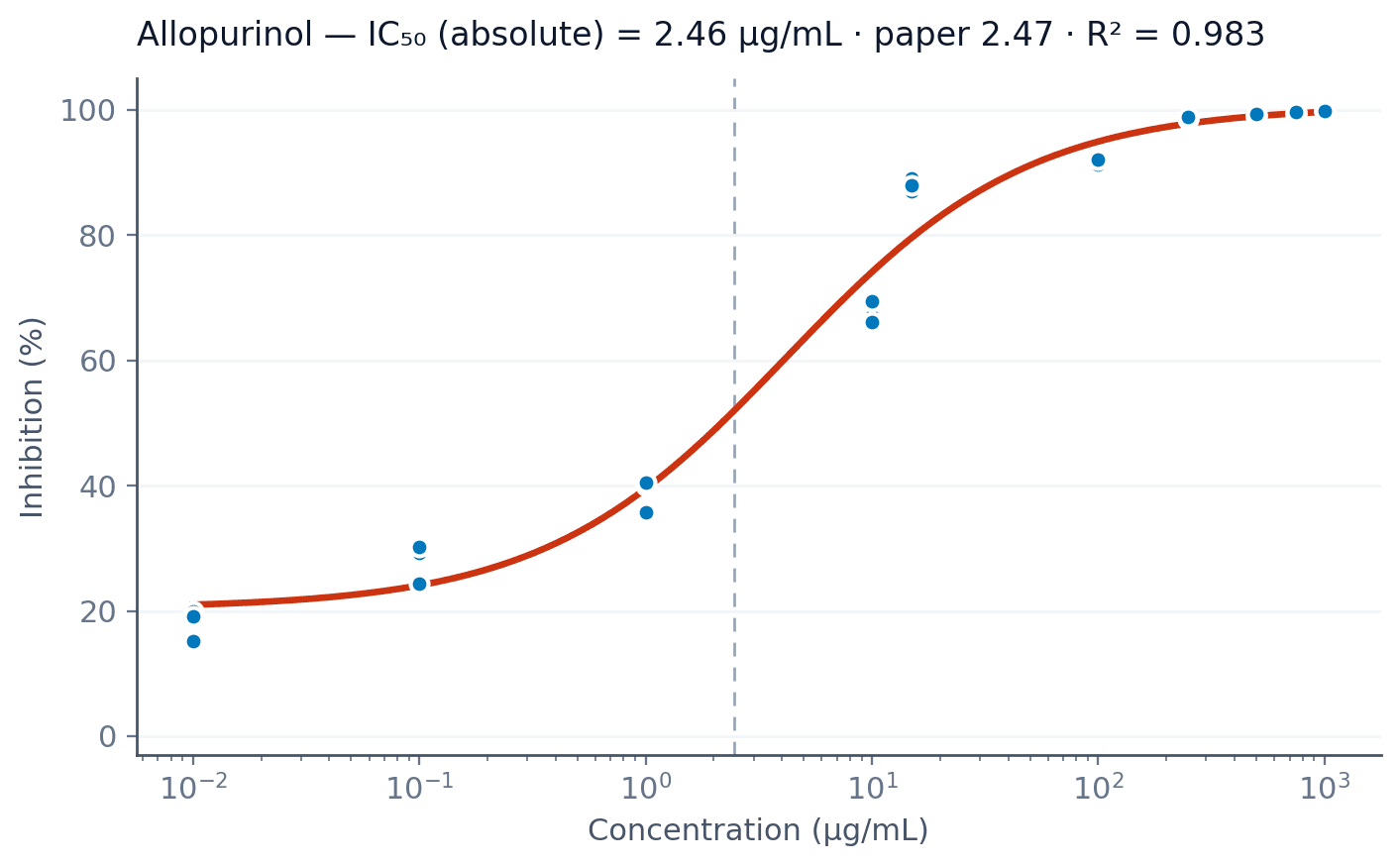
Allopurinol dose-response 4PL fit (paper IC50 2.47 µg/mL, Gradiance 2.46 µg/mL)
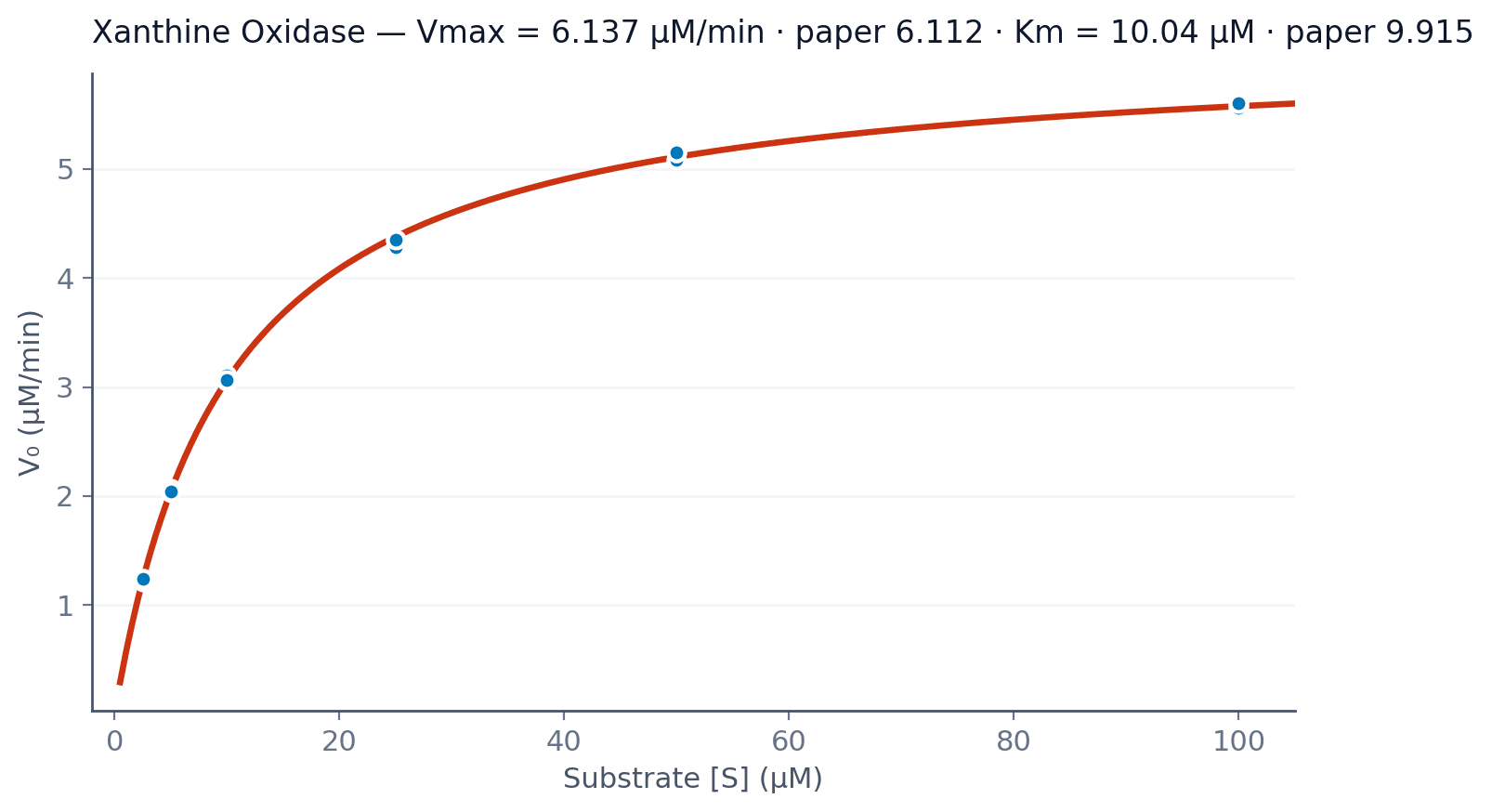
Xanthine oxidase Michaelis-Menten fit (paper Vmax 6.112 / Km 9.915, Gradiance 6.137 / 10.04)
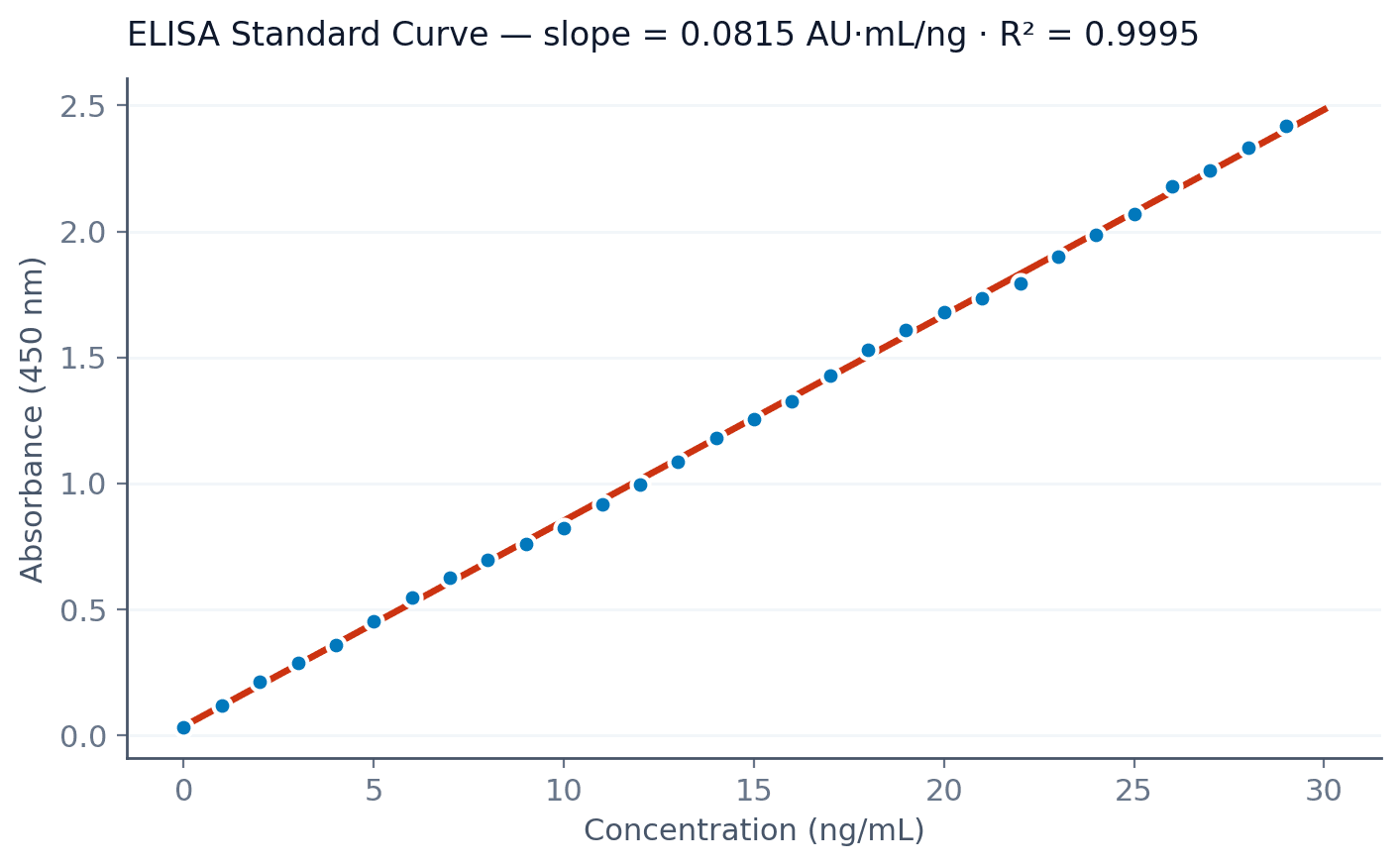
ELISA linear standard curve, R² = 0.9995
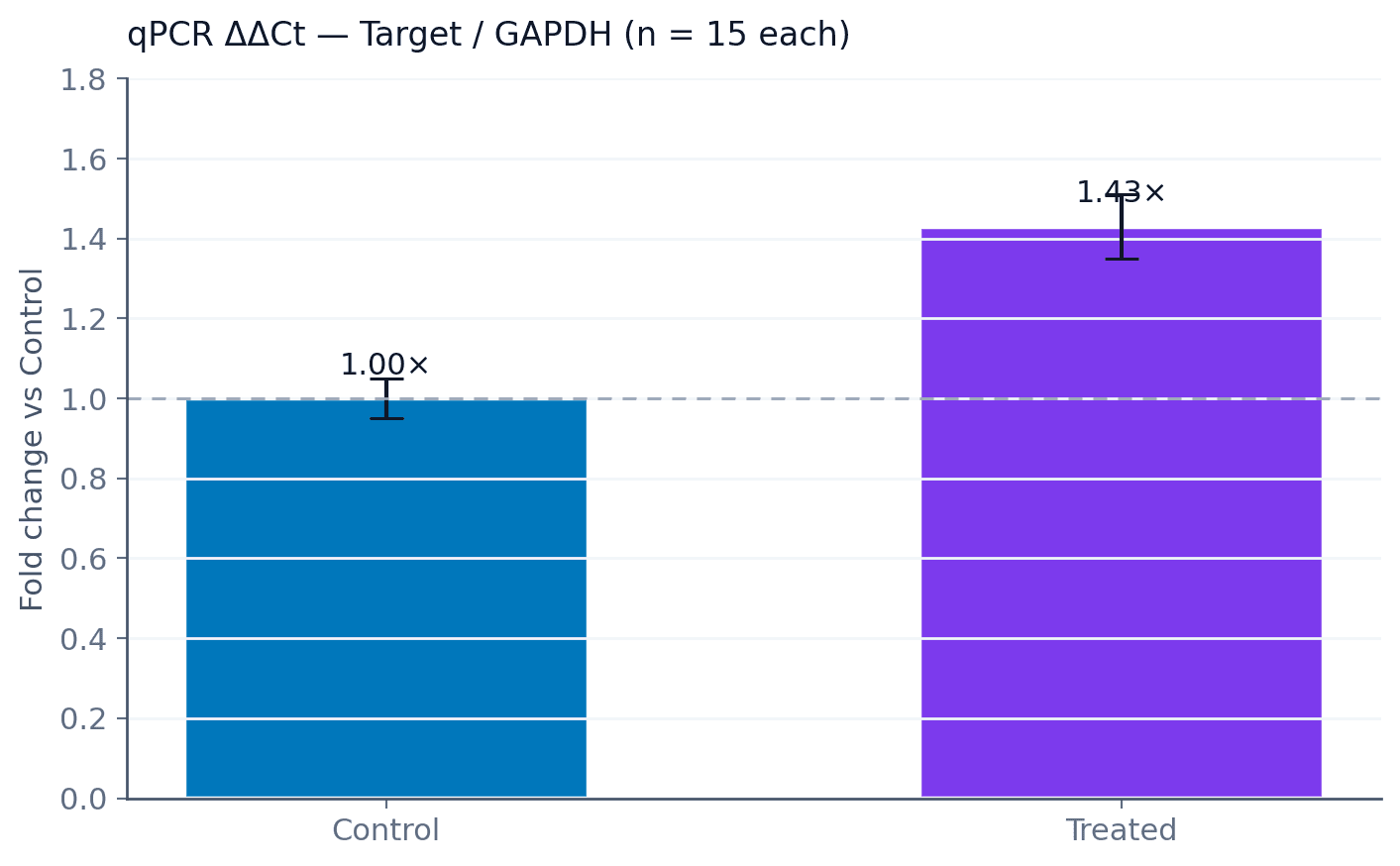
qPCR ΔΔCt fold-change of Treated vs Control (n=15 each)

Time you spend on science,
not on troubleshooting plates.

<5
minutes per assay

Cuts template wrangling and curve fitting to a few minutes.

0%
reproducible

Every parameter, every well — re-runnable to four decimal places.

0
assay types

With confidence intervals on every fitted parameter.

Four steps. That's it.

sample_03.csv19 rows
concentration_nM,response_pct
0.0300,96.37
0.0540,94.68
0.0972,92.92
0.1750,89.21
0.3149,83.71
0.5669,74.59
1.0204,61.08
1.8367,46.38

Drop your data

CSV or Excel from any plate reader. Messy headers, mixed formats — handled.

Gradiance detectedDose-response
Dose columnIC₅₀ / EC₅₀nM
ResponseInhibition%
Replicates3 per group
Confirm or override any field

Auto-detected

Gradiance identifies your assay type, dose column, and replicates. Confirm or override any field.

Dose-response fit
IC₅₀
1.04 nM
Hill
−1.2
0.998

Fit + statistics

Confidence intervals on every parameter. R² and quality metrics in the stats panel.

Compound A — Dose-Response02550751000.1110Concentration (nM)Inhibition (%)IC₅₀ = 1.04 nMMeasured4PL fit
IC₅₀ = 1.04 nM|95% CI: 0.91–1.19|R² = 0.998

Publication-ready

A journal-quality figure with 95% CI — plus a PDF report with method and provenance.

Publication-ready results,
automatically.

Every fit comes with confidence intervals, R², a model equation, and clean exports. Switch palettes, copy LaTeX, or download the underlying data — all from the same view your reviewers will see.

Run #4127

4PL Sigmoidal

· Compound A

y = Bottom + (Top − Bottom) / (1 + (IC50/x)^Hill)

Demo
R² = 0.9980
IC₅₀
1.04 nM
CI 95% [0.910–1.19]
0.998
excellent
RMSE
1.84
n = 18
excellent fit
18 points · 4PL Sigmoidal
excellent fitR² = 0.998

RMSE 1.84 · 14 DoF

Model equation

y = Bottom + (Top − Bottom) / (1 + (IC50/x)^Hill)

Fitted parameters

IC₅₀
1.04nM
± 0.07[0.91, 1.19]
Hill
1.82
± 0.12[1.58, 2.06]
Top
98.4%
± 1.10[96.20, 100.60]
Bottom
2.10%
± 0.80[0.50, 3.70]

Interpretation

The compound demonstrated potent inhibition with an IC₅₀ of 1.04 nM (95% CI: 0.91–1.19 nM). The Hill slope of 1.82 suggests positive cooperativity. Model fit is excellent (R² = 0.998, RMSE = 1.84%). No outliers detected.

Quality checks

Excellent model fit (R² = 0.998)
Both asymptotes well-defined (Top = 98.4%, Bottom = 2.1%)
No outliers detected at α = 0.05

Export & cite

sha256:4127…demo

AI-assisted analysis · validated algorithms · verify results independently for critical decisions.

Every assay you run, handled correctly.

IC₅₀ · EC₅₀

Dose-response

Sigmoidal curve fitting with confidence intervals on IC50, Hill slope, and asymptotes.

ELISA

Standard curves

Calibration with back-calculated unknowns, LOQ/LOD, and recovery.

Relative quantification

qPCR ΔΔCt

Reference-gene normalization and fold-change with propagated error.

Michaelis–Menten

Enzyme kinetics

Km and Vmax from initial-velocity data. Non-linear regression, no linearization.

Kd · Bmax

Saturation binding

Specific binding corrected for non-specific signal, with Kd and Bmax.

MTT · XTT · Resazurin

Cell viability

Viability % vs. dose with background subtraction and replicate handling.

IC₅₀ · EC₅₀

Dose-response

Sigmoidal curve fitting with confidence intervals on IC50, Hill slope, and asymptotes.

ELISA

Standard curves

Calibration with back-calculated unknowns, LOQ/LOD, and recovery.

Relative quantification

qPCR ΔΔCt

Reference-gene normalization and fold-change with propagated error.

Michaelis–Menten

Enzyme kinetics

Km and Vmax from initial-velocity data. Non-linear regression, no linearization.

Kd · Bmax

Saturation binding

Specific binding corrected for non-specific signal, with Kd and Bmax.

MTT · XTT · Resazurin

Cell viability

Viability % vs. dose with background subtraction and replicate handling.

Built to survive peer review.

Every parameter, every well — a complete chain of custody from raw file to published figure.

Run #4127 · provenance
Verifying…
  1. 00:00:00sample_03.csv ingested
  2. 00:00:08Mapping confirmed · IC50
  3. 00:00:234PL fit converged
  4. 00:03:11Figure exported · PNG/SVG/PDF
IC₅₀
1.04 nM
95% CI
0.91 – 1.19
0.998

Reproducible by design

Every result links to a standalone Python script with the exact inputs and parameters embedded. Re-run it a year from now and get the same fit.

Statistically honest

Confidence intervals on every fitted parameter. No silent outlier dropping. R² always shown.

Reviewer-ready exports

PDF reports include method, parameters, raw data, and a versioned trace — paste straight into supplementary.

“We built Gradiance because every lab deserves a reproducible analysis workflow — not a spreadsheet held together with macros and good intentions.”

The Gradiance team

Free to start. Affordable to stay.

Free
$0forever

Full analysis. No time limit. Ideal for evaluation and one-off projects.

  • 3 runs / month
  • All assay types
  • PNG export
Start free
Recommended
Pro
$29/ month

Built for recurring lab workflows. Higher throughput, every export format, audit reports.

  • 100 runs / month
  • PDF + SVG export
  • Live code view
  • Priority support
Go Pro
Team
$99/ month

Collaboration, governance, and shared workflows for an entire group.

  • Unlimited runs
  • Shared workspaces
  • SSO + audit logs
  • White-glove onboarding
Talk to us

Run your next assay
in Gradiance.

No credit card. Drop a CSV and have results in minutes.

We don't sell data
Audit trail built in
Open methodology